Wax upon a time. The Medici and the arts of ceroplastics


The very first exhibition dedicated to ceroplastics in the Gallery: ninety works have been given a home in new exhibition spaces
The story of the masterpieces of ancient wax sculpture is the guiding thread of the new Uffizi exhibition, ‘Cera una volta. I Medici e le arti della ceroplastica’. The exhibition is being hosted from 18 December 2025 to 12 April 2026 in the new spaces built in recent months and now specially set up on the Gallery’s ground floor.
Curated by Valentina Conticelli, Andrea Daninos and Simone Verde, this is the very first exhibition dedicated to the Florentine collections of wax sculpture from the 16th and 17th centuries. As the title says, it aims to shed light on an incredible lost creative field: that of the production of wax images, always living since ancient times in the popular sensibility and destined to experience a particular renewal of interest among the ranks of fine arts in Medici Florence from the 15th to the late 17th centuries.
Soft and neutral, if fashioned by the skilled hands of Renaissance sculptors, it could bring substance to faces and bodies in the form of everlasting images. With the Baroque culture, obsessed as it was with the passage of time, this organic material born from bees, which due to its malleable nature imitates the characteristics of the skin like no other, comes into its own in giving shape to the living body and its dissolution. Production of it was widespread but largely lost. Not only due to the substantial perishability of the material, but above all for the resistance of critics in welcoming its creations among the so-called ‘major arts’: a cultural phenomenon which greatly favoured their loss.
The aim of ‘Cera una volta’ is therefore to make wax sculpture better known – still today confined to a sort of unconscious realm of art history – at the moment of its greatest splendour, when, having reached very high forms of virtuosity, it was avidly sought for noble collections; and to highlight how, even in this field, the Medici were avant-garde collectors, capable of fully understanding the value of these types of object and protecting and hiring their creators. All of which continued until, in 1783, with an auction sale ordered by the Grand Duke of Tuscany Pietro Leopoldo di Lorena, almost all of these works were scattered to the winds.
SCIENTIFIC REVELATIONS
From a scientific point of view, and precisely in order to fully acknowledge the artistic dignity of wax sculpture, the exhibition intends to defuse some clichés relating to the origins and cultural nature of this art, and propose how to look beyond them. According to art historians Aby Warburg and especially Julius Schlosser, the Renaissance portrait, as well as the busts of Roman tradition, would have been heirs to wax casts of the faces of the dead, thus representing an ‘ancestral’ creation, characterized by religious and mystical values. Schlosser hinged his reasoning on Vasari, who in turn had looked to Pliny.
According to the thesis underlying the exhibition, however, the historical reconstruction proposed by Vasari would have been part of a propaganda operation, which the author of the Lives would have carried out with the aim of placing the sculpture of his time as a ‘direct descendant’ of that of Rome, falsely claiming Florence’s customs and traditions as heirs of imperial history. An operation in which Schlosser believed, building a theoretical framework on it influenced by the development of the anthropology, psychoanalysis, and positivism of his time, but in a substantial denial of the documents and the real history of ceroplastics.
In fact, according to the sources, the Renaissance casting technique used clay and not wax. So it had nothing to do with ancient wax sculpture or with the wax images of the dead of the Ancient Roman world. In Florence, instead, the spread of wax sculptures would appear only with the rise of the bronze industry, at the beginning of the 15th century, in particular with the arrival of the ‘lost-wax’ technique introduced by Lorenzo Ghiberti in moulding the doors of the Baptistery of Florence. The serial reproduction of models made from this material, essential for casting, would only then become a commercial by-product for the workshops which, in addition to busts and statues, would also begin to make small objects inspired by medal-making processes. The exhibition accurately reconstructs these events, scrupulously adhering to the historical sources and disregarding evocative interpretations linked to the sphere of magic and the occult to restore to wax sculpture its dignity in the history of sculpture.
EXHIBITION NOVELTIES
In the context of a forgotten history that has now been rediscovered and reinterpreted in all its wonder, the exhibition will offer some works once on show in the Tribuna of the Uffizi and at Palazzo Pitti, removed from the collections at the end of the 18th century, which after centuries will be returning to the museum for the first time.
A total of around 90 works will be on display, with many loans coming from other museums: in addition to the vast selection of waxworks, paintings, sculptures, cameos and works in semi-precious stone. Here we will be able to admire the Screaming Soul in Hell attributed to Giulio de’ Grazia and the famous plaster mask of Lorenzo the Magnificent, made by the waxworker Orsino Benintendi.
An entire room will be dedicated to the greatest wax sculptor active in Florence at the end of the 17th century: Gaetano Giulio Zumbo.
A recent acquisition of the Galleries by Zumbo will also be presented to the public. This work is entitled The Corruption of Bodies, a theme also typical of this virtually unknown artist: a small masterpiece of wonderful ceroplastics, thanks to which the memory of his most famous works will remain alive at the Uffizi.
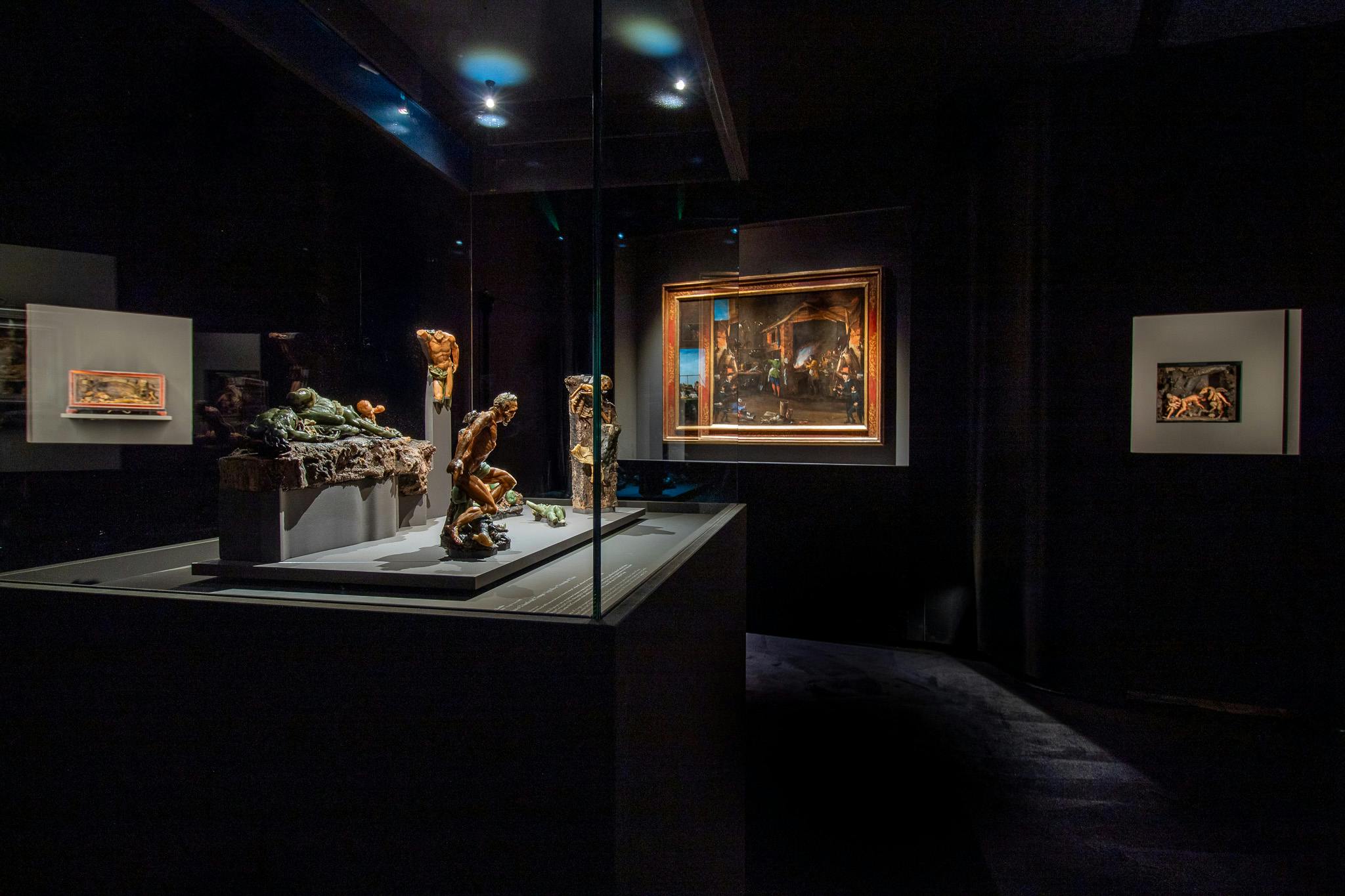
The layout, deliberately designed in the form of a tortuous labyrinth, aims to poke fun at the psychoanalytic and occult interpretations of wax art typical of the early 20th century, making the exhibition an odyssey through its masterpieces and universal masters, but also within the critical awareness of art history.
The Director of the Gallerie degli Uffizi, Simone Verde: ‘With this exhibition we want to free wax sculpture from “mythological” theories that would prefer it to be unrealistically linked to the primitive root of the European aesthetic unconscious, by anchoring it instead to the rigour of the facts and reports of art history. Thanks to a careful dismantling of the prejudices that have weighed heavily on this matter, we have worked to restore to the complete dignity of artists such irreplaceable figures for the mastery and creativity of European sculpture like Gaetano Zumbo.’
Orsino Benintendi, attributed (Florence, 1440 - after 7 October 1504) and Giovanni Antonio Sogliani, attributed (Florence, 1492-1544), Funeral mask of Lorenzo de' Medici, the Magnificent 1492 and 1512-1513 or 1515, patinated plaster, painted and gilded frame, at the top “p.p.p.”, at the bottom 'cruel death that / came upon this body / that after death the world went on / while he kept everything in peace ', Florence, Academy of Sciences and Letters La Colombaria, on deposit at the Uffizi Galleries, Palazzo Pitti, Treasury of the Grand Dukes
Exhibition ‘Wax upon a time’, photos of the exhibition setup
Exhibition ‘Wax upon a time’, photos of the exhibition setup
Exhibition ‘Wax upon a time’, photos of the exhibition setup
Exhibition ‘Wax upon a time’, photos of the exhibition setup
Exhibition ‘Wax upon a time’, photos of the exhibition setup
Exhibition ‘Once upon a time’, photos of the exhibition setup
Exhibition ‘Wax upon a time’, photos of the exhibition setup
Exhibition ‘Wax upon a time’, photos of the exhibition setup
Exhibition ‘Wax upon a time’, photos of the exhibition setup
Exhibition ‘Once upon a time’, photos of the exhibition setup
Giulio de Grazia attributed, (documented in Naples from 1598 to 1641), Damned Soul, circa 1600–1620, polychrome wax, glass, bone, mica, mirror, Florence, Uffizi Galleries, Palazzo Pitti, Grand Ducal Treasury
Ceroplast active in Tuscany in the first half of the 17th century, Saint Mary Magdalene Reading, circa 1610–1620, polychrome wax on painted glass, wood, plant fibres, paper, ivory, Florence, Palazzo Pitti, Grand Ducal Treasury
Exhibition ‘Wax upon a time’, photos of the exhibition setup
Exhibition ‘Wax upon a time’, photos of the exhibition setup
Exhibition ‘Wax upon a time’, photos of the exhibition setup
Giuseppe Antonio Torricelli (Fiesole, 1659 - Florence, 1719), Bust of Vittoria della Rovere, 1696-1713. Volterra chalcedony, sardonyx agate, jasper, petrified wood, white jasper from Volterra, Flemish paragone, chalcedony, in Florence, University Museum System of the University of Florence, Villa La Quiete
Exhibition ‘Wax upon a time’, photos of the exhibition setup
Exhibition ‘Once upon a time’, photos of the exhibition setup
Exhibition ‘Wax upon a time’, photos of the exhibition setup
Gaetano Giulio Zumbo (Syracuse, 1656 - Paris, 1701), Gallic Disease or Triumph of Time, circa 1690-1695, polychrome wax, Museum of Natural History of the University of Florence, Zoology Section ‘La Specola’, Anatomical Wax Collection
Exhibition ‘Once upon a time’, photos of the exhibition setup


THE VISIT
In the first room are exhibited funeral masks – in particular that of Lorenzo de’ Medici from 1492 – and sculpture portraits made using casts, some also life-size. This is to show the broader context in which the art of casting was expressed in the Florentine Renaissance and of which ceroplastics represented just one of the many production areas.
The second section is dedicated to the polychrome waxworks of the 16th century starting with those mentioned as being in the Tribuna of the Uffizi, whose inventory lists various artists, Martino Pasqualigo, Giovanni Battista Capocaccia and Costantino de’ Servi, some of whose works will be on show. Together with these, the wax portrait of Francesco I de’ Medici, by Pastorino Pastorini, to whom Giorgio Vasari attributed the invention of polychrome wax, that is, one where colour is mixed into the raw material. Another theme dear to 16th-century wax sculpture was that of wax beauties, dressed or ‘naked’, amassed in Florence also by Bianca Cappello, exhibited next to a series of little portraits of illustrious men, again in wax.
The next section investigates a theme that was very common in the wax sculpture of the early 17th century, that of the ‘Four Last Things’, in other words, the last unknown things that humans have to face: Death, Judgment, Hell and Heaven. Alongside two examples kept in the Treasury of the Grand Dukes in Palazzo Pitti, a series of versions of the same subject from various museums will be exhibited.
The last section is dedicated to the most famous wax sculptor active in the second half of the 17th century, Gaetano Giulio Zumbo, who worked in Florence from 1690 to 1695, in particular in the service of the Grand Prince Ferdinando de’ Medici. The Plague, arguably his most famous work, is juxtaposed, as in the 18th-century layout, with a painting depicting the Head of Medusa, at the time believed to be by Leonardo. It will be possible to admire the two fragmentary groups depicting Syphilis or the Triumph of Time, now divided between the Museo della Specola and the Museo Mozzi Bardini, the little-known, but extraordinary, Scene of Witchcraft from the Sassari art gallery and a relief depicting the Corruption of Bodies, recently purchased by the Gallerie degli Uffizi.
Zumbo’s waxworks will be accompanied by a series of paintings of alchemical and witchcraft subjects: The Witch by Salvator Rosa, recently purchased by the Uffizi, and some other waxworks inspired by this Sicilian master.
On the occasion of the exhibition, the Gallerie degli Uffizi have sponsored numerous restoration works on wax and terracotta works belonging to Florentine, Italian and foreign institutions, thanks to which it will be possible to better appreciate their quality. These interventions have also made it possible to deepen knowledge on the methods of crafting of these rare artifacts.
Particularly relevant is the contribution of the museums of the University of Florence, which have exceptionally lent the two works by Gaetano Giulio Zumbo The Plague and Syphilis or the Triumph of Time, restored for the occasion; this meant that more than half of his entire artistic production could be brought together in the exhibition for the first time.