At the Pitti Palace, the “very best” of the king’s furniture


In the Palatine Gallery the Niche Room is home to a selection of masterpieces of artistic furnishings across three dynasties: the Medici, Lorraine, and Savoy.
Pitti was the testing ground for the aesthetics of the Quirinal Palace’s interiors: many items from the Florentine palace – some of which originating from Parma, Lucca, and perhaps even Versailles – were gifted to the crown, thus becoming part of the holdings of the Presidency of the Italian Public.
The very best of three centuries (from the 17th to the 19th) of royal furnishings, recounted through the evolving interior decoration styles of three dynasties – the Medici, Lorraine, and Savoy –, has been concentrated in a selection exhibiting 16 genuine furniture masterpieces that also outline the Palace’s cultural history. On the first floor of the former sovereign residence of the Pitti Palace, the Palatine Gallery’s Niche Room now offers a complete anthology of royal furniture. Decorative armchairs, vases from the Manufacture de Sèvres and others imported from China, Giovanni Socci’s legendary mechanical writing desk, a kneeling stool made by Leonardo van der Vinne and adorned with precious stones, and a unique stipo providing a perfect scale reproduction of the Pitti Palace: all these items, through their shapes and decorations, speak to the visitor about how the sovereigns’ tastes and “domestic” aesthetics changed over time. The visitor is thoroughly initiated in the Palace’s heritage of furniture and the decorative arts – that is, in the discovery of an inheritance that, although among the most important of its kind in Europe, is still virtually unknown. Today, while very little remains of the Renaissance decor at Pitti, thousands of items bear witness to the Baroque period, to 17th century Neo-Classicism, and to Savoy eclecticism. Of the objects on display in the Niche Room, visitors can admire the virtuoso 17th-century works of intarsia and “commesso” – that is, the inlay of gemstones from Botteghe Granducali degli Uffizi, the grand ducal workshops. With the rise of the Lorraines, the court’s taste – also in furnishings – adapted to the new European styles, abandoning the decorative flamboyance of Baroque for the lightness of oriental lacquer and sinuously-shaped furniture. With Ferdinand III, certain environments in the Pitti Palace were transformed in accordance with the dictates of the Neo-Classical style; under French rule, Elisa Baciocchi, Napoleon’s sister, refurnished some of the palace’s rooms with pieces in Empire style. During the Restoration, this style was also adopted by Ferdinand III and his son Leopold II to complete the palace’s interior decorations, as the furnishings’ severe lines were adjusted to the various stylistic revivals brought back into vogue by 19th-century aesthetes, in keeping with a taste that was also prized by the Savoys after Italian Unification.
Lastly, the Savoys are to be credited with the Palace’s final aesthetic rebirth. Stripping of their furnishings the other sovereign residences in the pre-Unification states that had been absorbed into the Kingdom of Italy (Lucca, Milan, but also Colorno and Parma where, in the mid-18th century, the daughter of Louis XV of France reigned after snatching up the pieces “discarded” at Versailles), they developed a particular form of eclecticism based upon the synthesis of the "manners" of the past, achieved through a casual blend of new and ancient pieces.
The room’s exhibit concludes with this dynastic episode, which made Pitti a genuine testing ground for the furnishings in the Quirinal Palace. In fact, a great deal of the Florentine palace’s decor was gifted to the monarchy, thus ending up at the Quirinal and becoming a definitive part of the holdings of the Presidency of the Italian Republic.

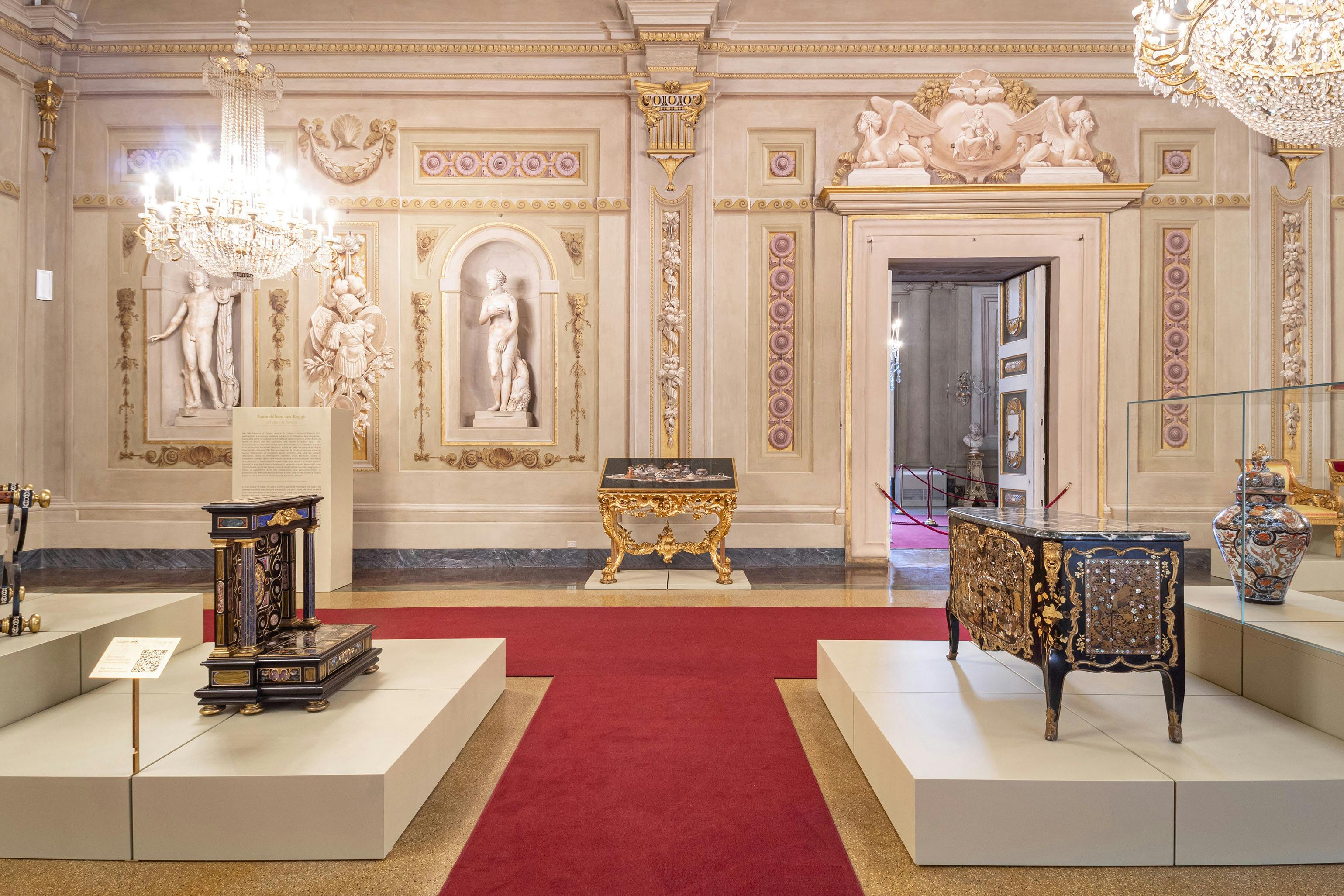
The Hall of Niches in Palazzo Pitti with an exhibition of furniture
According to Simone Verde, Director of the Uffizi Galleries: “This section was one of the projects submitted during the weeks when my term began and, first and foremost, it helps make the royal palace more legible to the visitor. And the visitors themselves, once they have experienced this space, will be able to show greater attention when viewing the heritage of furnishings in the other rooms they will be passing through – starting from the royal apartments that have been open for a year now. Moreover, this is a recognition for all those who, for decades (and I have both Enrico Colle and Alvar Gonzales Palacios in mind) have worked towards the long-due rediscovery of this creative world – a world in no way inferior to other forms of artistic invention in spite of unfairly established academic hierarchies that are now, fortunately, dead and buried. Lastly, by telling the Palace’s story through these pieces, a social history of art is produced spontaneously and in line with contemporary critical sensitivity.”

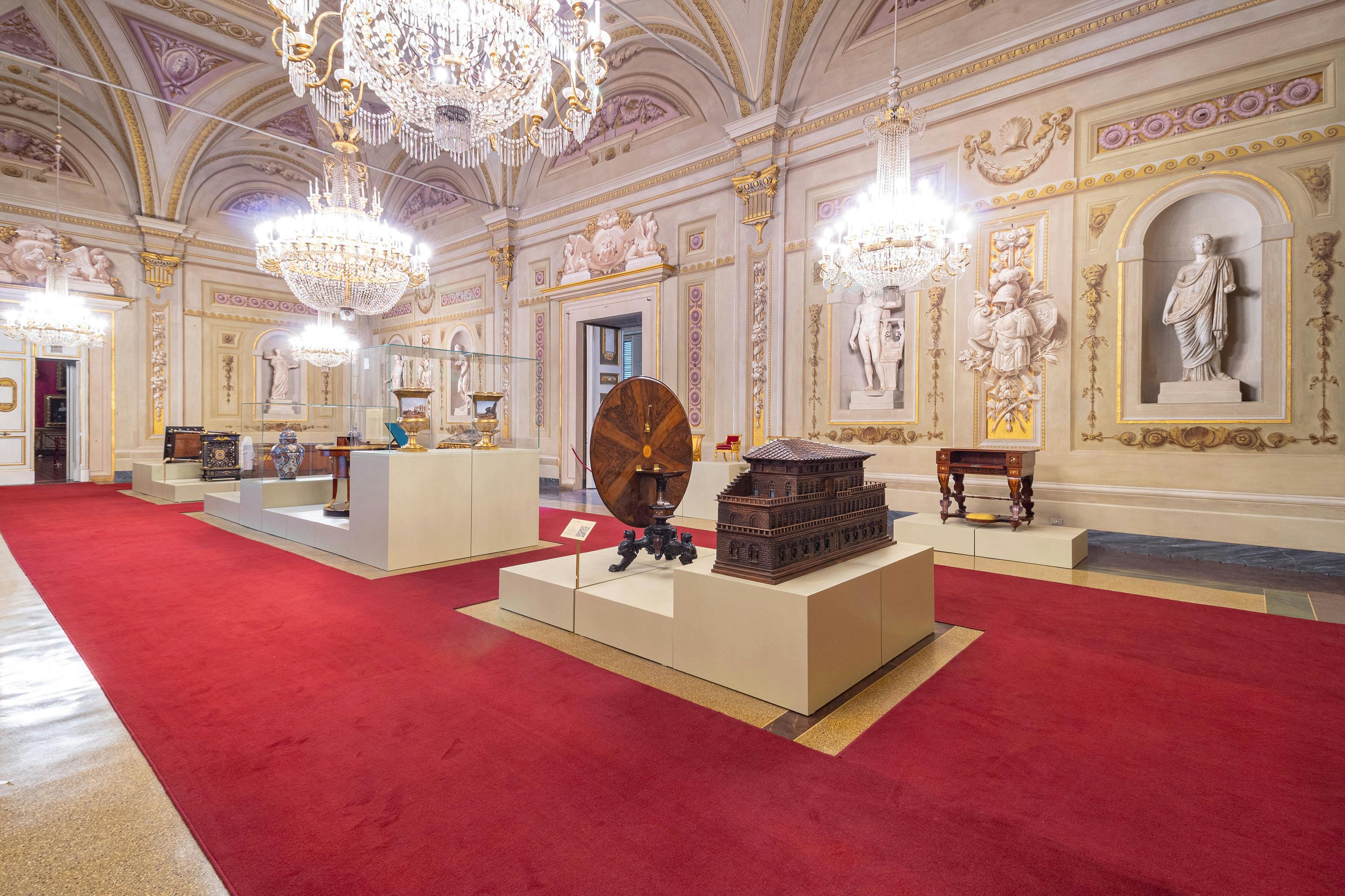
The Hall of Niches in Palazzo Pitti with an exhibition of furniture
… MEANWHILE, THE ROYAL PALACE NEVER STOPS
Meanwhile, in the former royal palace, work is in full swing as never before.
In addition to the restoration of the Niche Room housing the selection of royal furnishings, the lighting, again in the Palatine Gallery, has been redesigned and updated in the Green Room, the Music Room, and the Queen’s Bedroom. What’s more, the White Room’s floor (where the recovery of the stuccowork is also getting underway), freed of the old bookshop, is now wholly restored, as is the Vestibule of the Palatine Gallery along with the grand staircase accessing the floor. Lastly, a call for bids has been launched for the creation of a new entry system for visitors to the Pitti Palace.
Palatine Gallery’s Niche Room
Palatine Gallery’s Niche Room
Palatine Gallery’s Niche Room
Palatine Gallery’s Niche Room
Palatine Gallery’s Niche Room
Palatine Gallery’s Niche Room
Palatine Gallery’s Niche Room
Palatine Gallery’s Niche Room
Palatine Gallery’s Niche Room
Palatine Gallery’s Niche Room
Palatine Gallery’s Niche Room