A rare painting by Luca Giordano has entered our collection: Amici degli Uffizi-Friends of Uffizi Gallery donate "Christ and the Samaritan Woman"

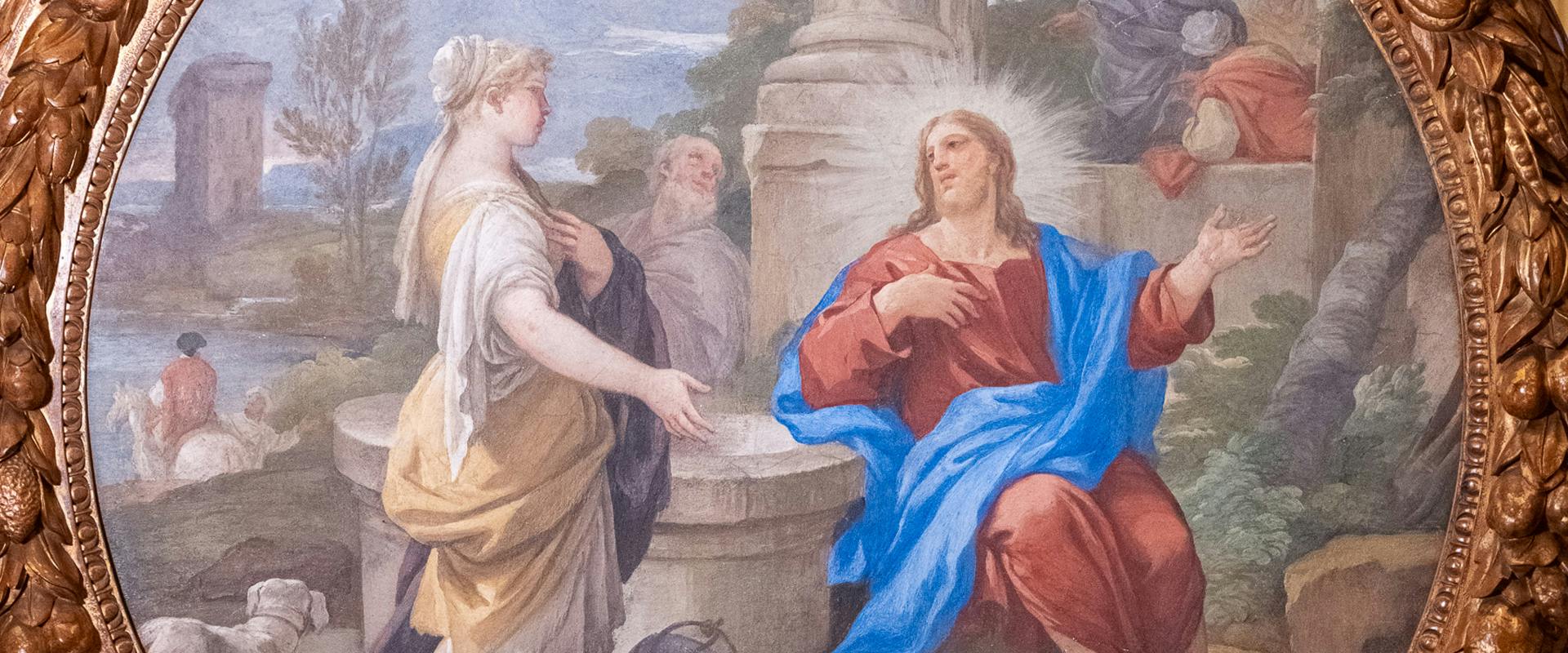
The work was painted in Florence in c. 1685 on a wicker tondo using a unique technique
Luca Giordano’s Christ and the Samaritan Woman —a painting of exceptional interest, also because of the rare technique involved—is returning to Florence, where it was painted around 1685. The fresco tondo is mounted on a “paniera,” a portable lightweight wicker support used by Giovanni da San Giovanni and other baroque masters in Florence and which Giordano also chose to adopt during his stay in the city.
The work, presented at TEFAF Maastricht 2026, was purchased by Amici degli Uffizi - Friends of the Uffizi Gallery and donated to the Uffizi Galleries. Not only a valuable addition to the museum’s collection, it also represents a significant piece of the history of 17th-century Florentine painting and of the Neapolitan artist Luca Giordano’s relationship with the city.
Highly sought-after by the Medici and the leading families of the Florentine aristocracy, Giordano painted this fresco on a “paniera” support with the customary speed of execution that earned him the nickname “Luca fa presto.” According to tradition, in fact, the painting was completed in just two days.
Giordano left behind one of his greatest masterpieces in Florence: the frescoes in the salon on the piano nobile in Palazzo Medici Riccardi, which are distinguished by a narrative that unfolds through a succession of scenes in a continuous cycle, as Pietro da Cortona had done in the rooms of the Planets at Palazzo Pitti. Giordano’s cycle represents a landmark in the history of monumental painting because it is the first time that this type of work did not include a painted architectural framework. We should note that Giordano painted his tondo depicting Christ and the Samaritan Woman just as he was completing the final stage of the decorations in Palazzo Medici Riccardi. This important addition to the Uffizi’s collection therefore allows the museum to link its narrative to this important chapter in the history of art.
Giordano—whose works in the Uffizi Galleries include a magnificent self-portrait—soon found favour among the Florentine nobility. Notable examples of his commissions included the fresco series for the Corsini Chapel of Santa Maria del Carmine, whose preliminary study was purchased by the Uffizi at the Biennale dell’Antiquariato di Palazzo Corsini in 2015.
Christ and the Samaritan Woman belongs to a series of four tondi “su paniera” commissioned by Andrea Del Rosso, member of a noble Florentine family, and was painted during the artist’s stay in Florence at Palazzo Del Rosso itself. Another painting from this series known today is Christ Among the Doctors, held at the Minneapolis Institute of Art.
The subject of the fresco, which is taken from the Gospel of John, shows Christ’s encounter with the Samaritan woman by Jacob’s well. The composition is remarkably direct and fresh, with the master employing brilliant, luminous colours that bring his style very close to that of Pietro da Cortona.
This donation expands the Uffizi’s collection of 17th-century Neapolitan painting, documenting the presence of illustrious exponents of this school in Florence.
The fresco will be displayed in the first-floor gallery—due to open soon—devoted to 17th-century painting: here, it will engage in a dialogue with other works by artists active in Florence in the same period, helping to convey to the public the complexity of the relationships between Florentine tradition and the international language of the Baroque.
Simone Verde, director of the Uffizi Galleries: “It is thanks to the great generosity of the Amici degli Uffizi – Friends of the Uffizi Gallery that we can present this acquisition today, which is of considerable significance for the Uffizi collections. Christ and the Samaritan Woman at the Well documents a very particular method of execution as well as providing valuable evidence of the contribution made to the Baroque in Florence by a European-level artist such as Luca Giordano. But what makes this addition to the collection even more noteworthy is the fact that Giordano painted it during the final stages of the important decorative cycle in the Galleria degli Specchi at Palazzo Medici. This allows us to connect the narrative of our museum to a key episode in art history.”
Luigi Salvadori, president of the Amici degli Uffizi: “This donation demonstrates the value of the collaboration between the Amici degli Uffizi and the Friends of the Uffizi Gallery, whose joint commitment makes a tangible contribution to the growth and promotion of the museum’s collections. For over twenty years, the Friends of the Uffizi Gallery have generously and consistently stood alongside the Amici degli Uffizi in their ongoing efforts to support the museum, making restorations and important acquisitions possible. The arrival of Luca Giordano’s Christ and the Samaritan Woman at the Well is further confirmation of how important this synergy is in preserving and enriching the Uffizi’s heritage and making it increasingly accessible to future generations.”
Luca Giordano
(Naples 1634 - 1705)
Christ and the Samaritan Woman
1685 c.
Fresco on wicker support, Diameter 111 cm